Interpolation filters
For interpolating data, Pandora2d uses its own interpolation filters. Those filters are used in the refinement step.
Bicubic
This filter uses the following kernel in 1D:

Where

and

In the following image, two lines of an image are sketched with on each a point to interpolate at indices 3.5 and 5.5:

For both points to interpolate, the fractional_shift is 0.5. Thus, the coefficients to apply to pixels’ values are the same for both points.

 values for which kernel is not null are available for
  ranging from
  to
to  .
.
Thus, for an image in 2D, the filter is applied on an array of shape  where coefficients are applied on columns then lines.
Sinc
This filter use a cardinal sine of the form:

Where is the fractional shift.
Computed coefficients are windowed by a Gaussian of form:
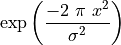
Where  correspond to the size of the filter (half width of the window).